Project Status#
OpenRath v1.2.0 is a usable multi-agent, multi-session runtime with first-class memory, internal async execution, provider integrations, and active hardening around lifecycle and durability. The main abstractions are implemented in src/rath, covered by tests, documented in the API reference, and exercised by the numbered example ladder. It is not yet a fully polished platform with long-term compatibility guarantees for every extension point.
Core model          Runtime path          Durability layer        Project quality
Session/Workflow -> async loop + tools -> persistence/config  ->  CI/docs/examples
Backend/Memory      local/OpenSandbox     local JSON/JSONL        Ruff + Actions
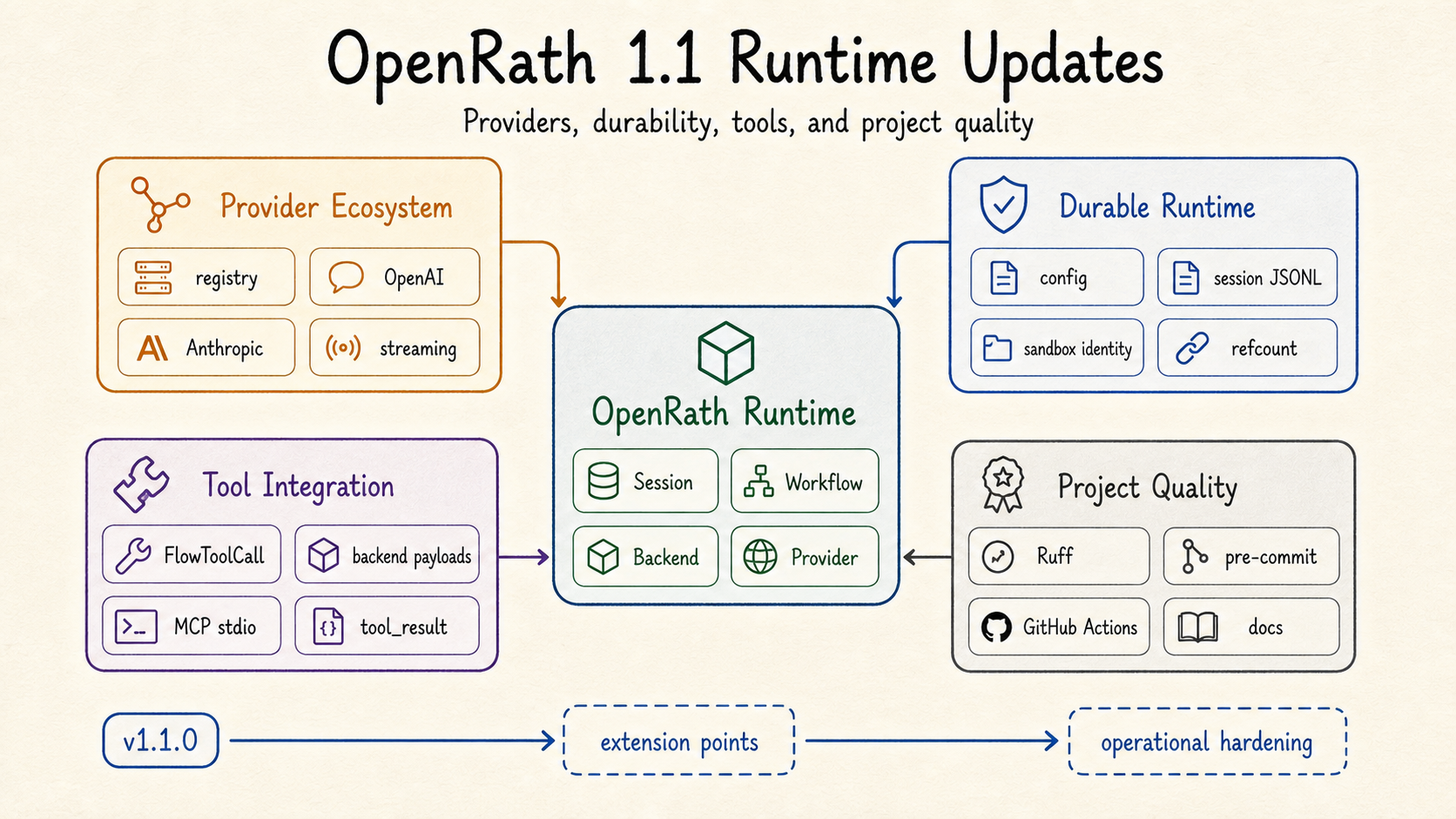
OpenRath v1.2.0 expands the runtime around memory, internal async execution, provider modalities, lifecycle hardening, and project quality.#
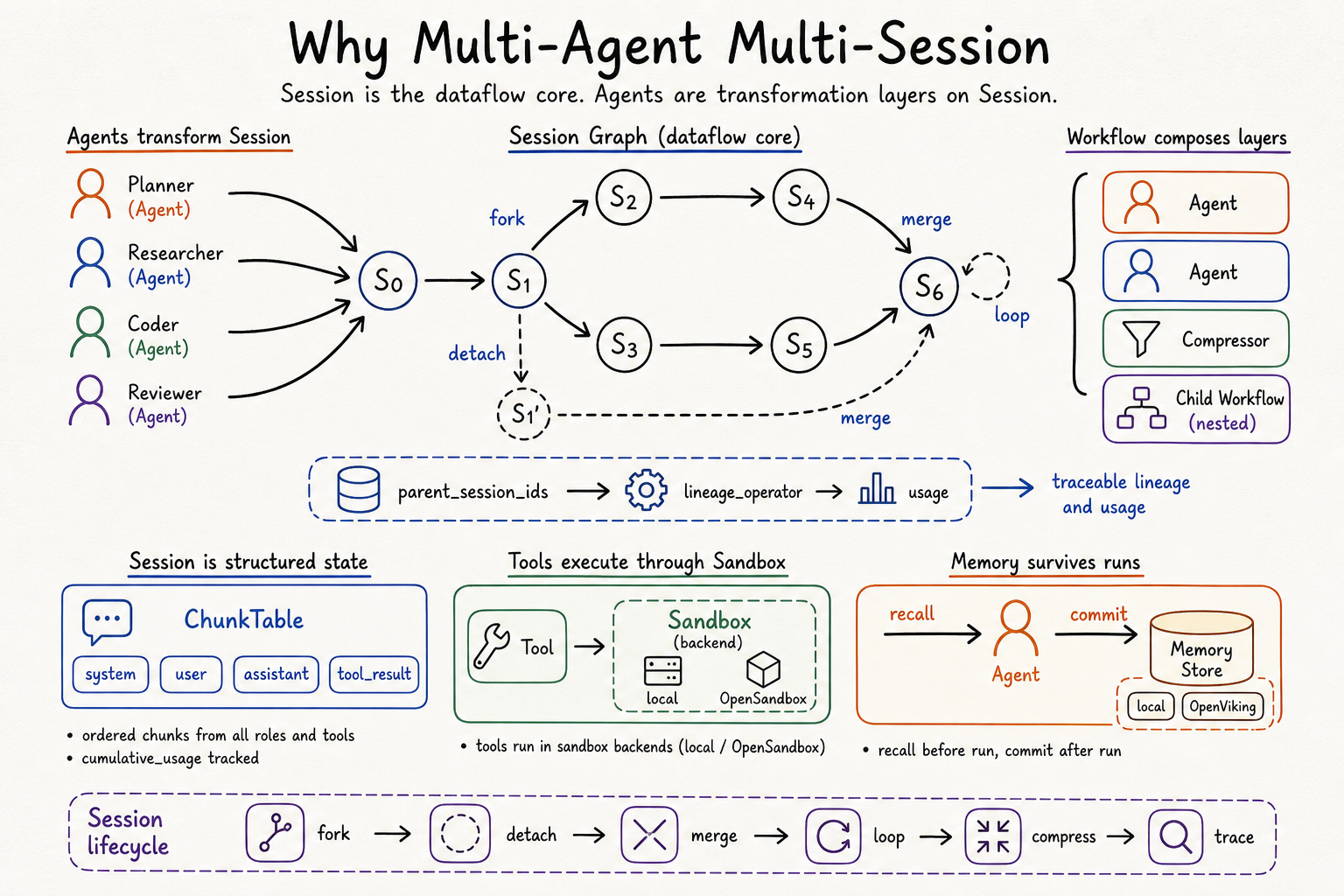
The v1.2 runtime treats multi-agent and multi-session flows as first-class session graph operations.#
Current Stage#
Layer |
Status |
What this means |
|---|---|---|
Session core |
Implemented and central |
|
Workflow API |
Implemented |
|
Tool runtime |
Implemented |
|
Memory plane |
Implemented |
Local memory is in the base install; OpenViking is optional; agents expose remember / recall / commit APIs. |
Local backend |
Usable |
Local command, file, and code payloads are supported and covered by conformance tests. |
OpenSandbox backend |
Integrated, still operationally sensitive |
Container execution works, with workspace bind fallback and CI coverage, but depends on external service/runtime setup. |
LLM providers |
Expanded |
OpenAI-compatible and Anthropic adapters exist behind a provider registry; embedding and VLM clients are available. |
Streaming |
Implemented for compatible clients |
|
Async runtime |
Implemented internally |
Public calls stay synchronous; returned sessions may lazily synchronize transcript and usage fields. |
Persistence |
Implemented, still early UX |
Session JSONL persistence, WAL partials, sandbox identity registry, and memory registry pieces exist. |
MCP integration |
Implemented as adapter |
Stdio MCP tools can be wrapped as |
CI and lint |
In place |
Ruff, pre-commit, pytest-xdist, timeout/rerun plugins, and GitHub Actions cover lint, tests, shellcheck, OpenSandbox, and OpenViking paths. |
Documentation |
Updated for v1.2.0 |
API reference and tutorials cover the new memory, async, provider, and example surfaces. |
What Is Stable Enough To Build On#
These areas are the current foundation of the project:
Capability |
Evidence in repo |
|---|---|
Session state model |
|
Workflow composition |
|
Backend abstraction |
|
Memory abstraction |
|
LLM request/response DTOs |
|
OpenAI-compatible client path |
|
Core tutorials/examples |
|
Test coverage shape |
|
The repository currently has dozens of focused test files across session behavior, backends, provider adapters, persistence, MCP, and conformance. That makes the codebase closer to an early framework than a one-off demo.
What Recently Moved From Design Into Runtime#
The latest development line adds memory, internal async execution, and lifecycle hardening around the core runtime:
Area |
Runtime change |
|---|---|
Memory plane |
|
Provider ecosystem |
Registry-based dispatch through |
Embedding and VLM |
|
Config |
Persistent |
Internal async runtime |
|
Session persistence |
Append-only JSONL writer/loader with WAL partials, crash detection, and resumable pairs. |
Sandbox persistence |
Local workspace and OpenSandbox remote identity registry. |
Sandbox lifecycle |
Refcounted live handles shared by loop outputs, forks, detaches, and merges, with lock-protected acquire/release. |
Merge primitive |
|
Streaming loop |
|
MCP tools |
Stdio MCP servers can be exposed to the loop as normal |
LLM resilience |
Retry policy, credential fallback, token usage accounting, and budget guardrail. |
Example ladder |
|
Project operations |
Ruff, pre-commit, pytest-xdist, timeout/rerun plugins, and split GitHub Actions matrices. |
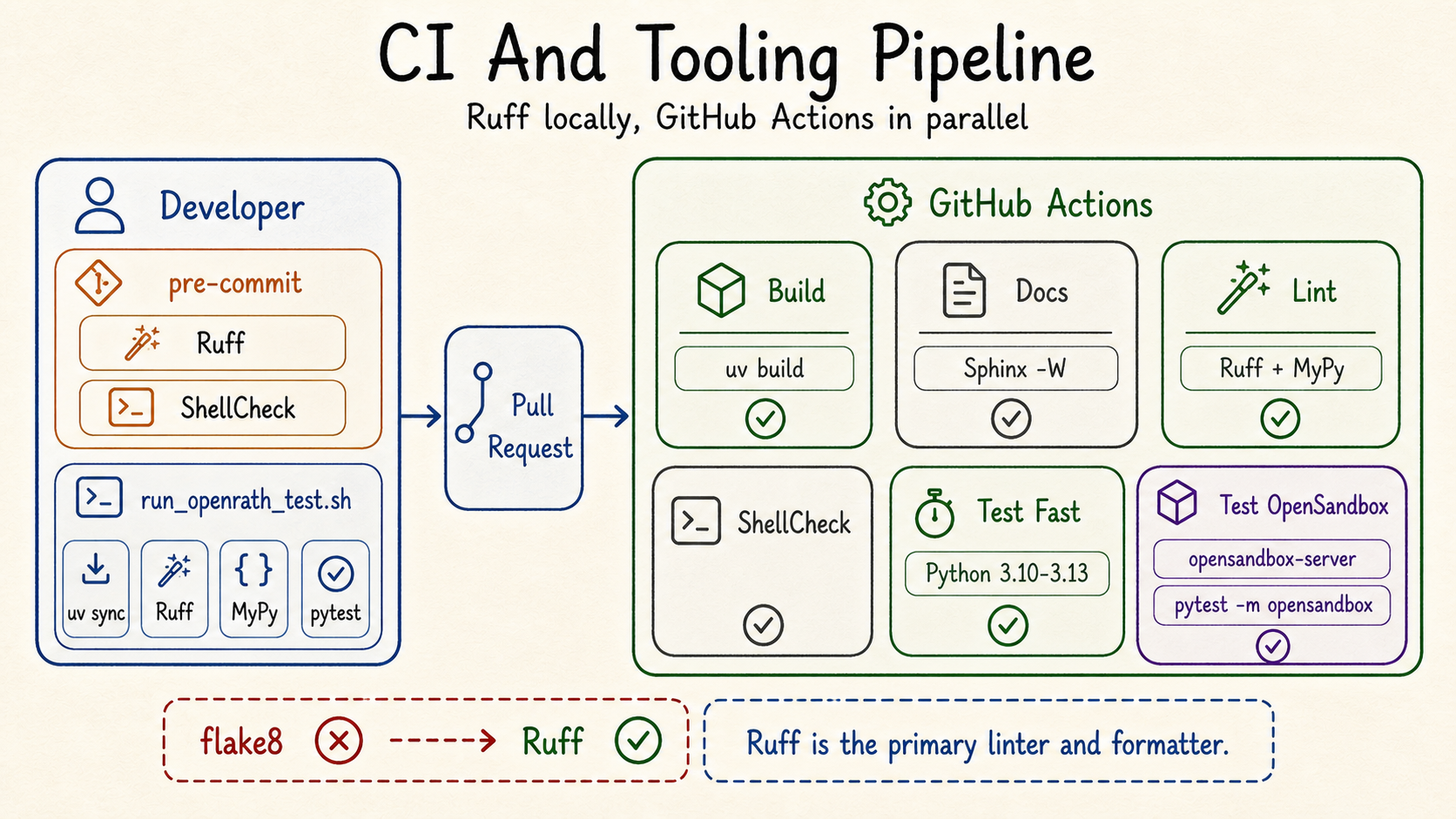
The current contributor path is guarded by Ruff, type checks, tests, docs builds, and GitHub Actions workflows.#
What Still Needs Productization#
These are the main areas that need continued work before the project feels like a mature public platform:
Area |
Current gap |
|---|---|
Persistence UX |
Low-level APIs exist; user-facing resume/cleanup workflows need clearer tutorials and examples. |
Config UX |
JSON config is implemented; CLI helpers or guided setup are not yet present. |
MCP scope |
Stdio transport works; HTTP/SSE transports are not part of the current adapter. |
OpenSandbox operations |
Backend integration exists; production deployment still depends on server/runtime configuration. |
OpenViking operations |
Optional memory backend exists; deployment still depends on service/runtime configuration. |
Docs coverage |
Public API reference and tutorials are aligned with v1.2.0; deeper persistence and OpenViking walkthroughs can still expand. |
Release communication |
Long-form announcement content should live on |
Compatibility policy |
Current release is |
Practical Interpretation#
For a new user:
OpenRath is ready to try for local agent workflows, structured session experiments, custom tools, local memory, and provider integration work.
It is especially useful if you want session state, tool execution, and workflow composition to be explicit Python objects.
For production use, validate provider credentials, memory store paths, sandbox lifecycle, persistence cleanup, and OpenSandbox/OpenViking deployment in your environment.
For a contributor:
The next highest-value work is not inventing new abstractions; it is tightening the user path around the abstractions that now exist.
Good follow-up work includes persistence tutorials, config setup helpers, OpenSandbox/OpenViking deployment notes, MCP transport expansion, and docs images for the new runtime layers.