Workflow#
Workflow is OpenRath’s composition layer. It organizes one or more agent configurations into a callable object and expresses runtime logic as Session -> Session.
This page explains the structure from single-agent to multi-agent workflows, AgentParam registration rules, nested workflow composition, and how session, sandbox, and tool traces move through the call chain.
The diagram below shows the intended mental model: a workflow is a callable
module over Session, and its internal agents can fork, compose, and compress
state explicitly.
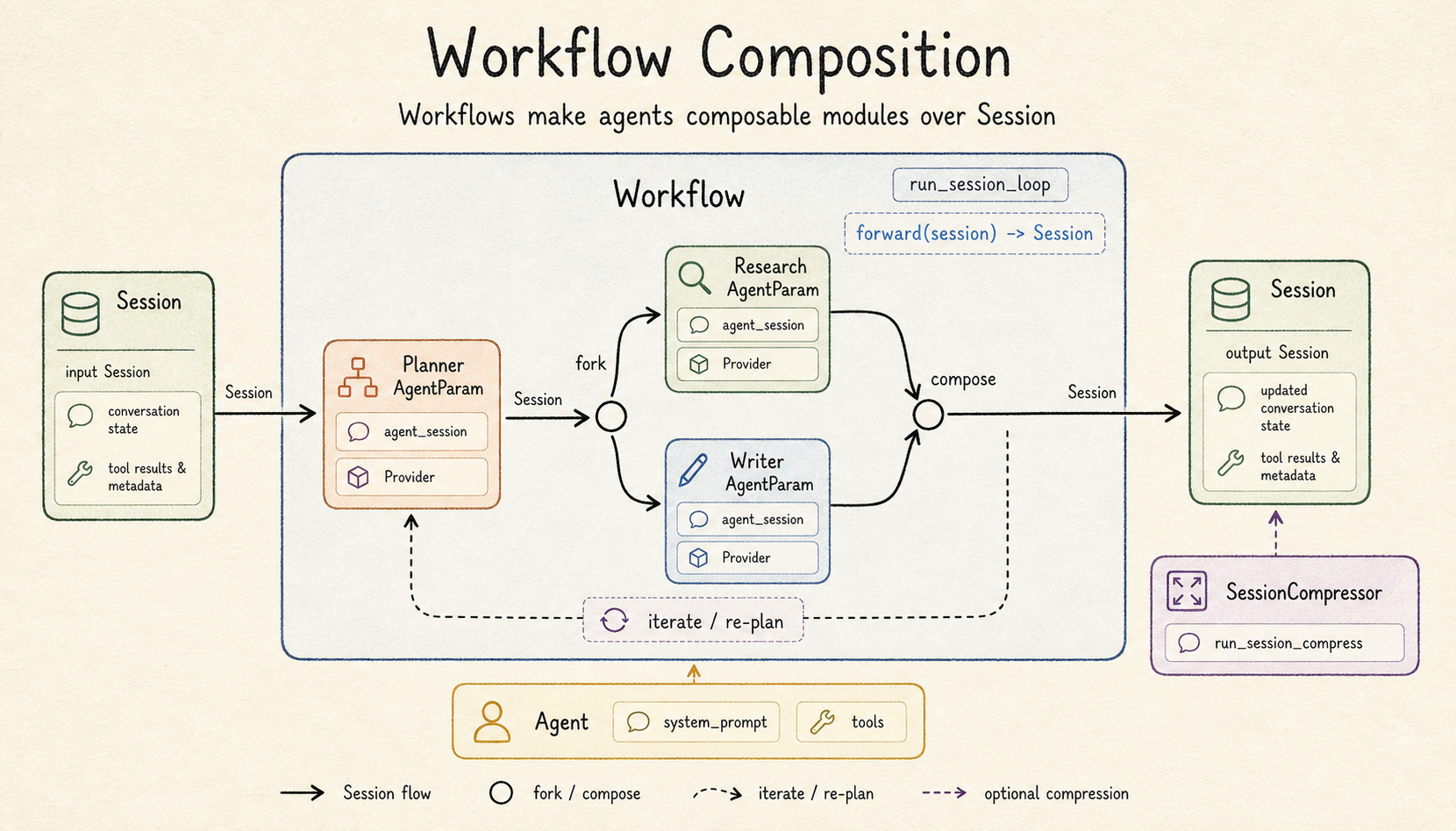
Workflow.forward(session) -> Session keeps orchestration in ordinary Python
while preserving session graph and sandbox traceability.#
Overview#
OpenRath workflows follow a pattern close to PyTorch modules:
PyTorch intuition |
OpenRath equivalent |
|---|---|
|
|
Child modules are attached as attributes |
|
Tensors move between modules |
|
Module tree can be printed |
|
Workflow has a small job: collect directly attached AgentParam values, provide the forward(...) convention, and make instances callable through workflow(session). Execution order, branching, compression, tool injection, and child workflow calls are written explicitly in normal Python code.
Source map#
File |
Responsibility |
|---|---|
|
|
|
|
|
|
|
|
|
Runs the LLM loop, tool calls, sandbox transfer, and lineage writeback. |
|
Smallest preset |
|
Preset |
Minimal Workflow#
Inherit from Workflow and implement forward(self, session) -> Session:
from rath.flow import Workflow
from rath.session import Session


class IdentityWorkflow(Workflow):
    def forward(self, session: Session) -> Session:
        return session
Workflow.__call__(session) directly calls forward(session). The base forward(...) raises NotImplementedError, so subclasses must define their own runtime logic.
AgentParam Auto-Registration#
When an AgentParam is assigned as a workflow attribute, Workflow.__setattr__ records it in _agents:
from rath.flow import AgentParam, Provider, Workflow
from rath.session import Session


class PlanningWorkflow(Workflow):
    def __init__(self):
        super().__init__()
        self.planner = AgentParam(
            Session.from_agent_prompt("Plan the work."),
            Provider(api_key="sk-...", model="gpt-5.5"),
        )
That assignment has two effects:
Result |
Behavior |
|---|---|
Python attribute |
Usable through |
workflow registry |
Visible through |
named_agents() returns a tuple sorted by attribute name. When an attribute is deleted, Workflow.__delattr__ removes the matching registered item from _agents.
Single-Agent To Multi-Agent#
The smallest runnable path can use the preset flow.Agent directly:
from rath import flow
from rath.llm import Provider

agent = flow.Agent(
    system_prompt="Answer clearly.",
    provider=Provider(api_key="sk-...", model="gpt-5.5"),
)

out = agent(user_session)
For multiple roles, define each role as an AgentParam and call run_session_loop(...) step by step in forward(...):
from rath.flow import AgentParam, Provider, Workflow
from rath.session import Session, run_session_loop


class ReviewWorkflow(Workflow):
    def __init__(self, provider: Provider):
        super().__init__()
        self.writer = AgentParam(
            Session.from_agent_prompt("Write a first draft."),
            provider,
        )
        self.reviewer = AgentParam(
            Session.from_agent_prompt("Review the draft and tighten it."),
            provider,
        )

    def forward(self, session: Session) -> Session:
        draft = run_session_loop(
            session,
            self.writer.agent_session,
            agent_provider=self.writer.provider,
        )
        return run_session_loop(
            draft,
            self.reviewer.agent_session,
            agent_provider=self.reviewer.provider,
        )
The first loop output becomes the second loop input. The session graph records the parents for each loop, and the sandbox handle moves from input session to output session.
Session Is The Composition Unit#
Workflow instances communicate through Session. That keeps several composition patterns consistent:
Pattern |
Code shape |
Use case |
|---|---|---|
Sequential call |
|
Roles work in a fixed order. |
Branching exploration |
|
Derive multiple candidate paths from the same context. |
Session-level parallelism |
|
Send multiple forked sessions to different agents at the same time. |
Detach from history |
|
Reuse content while cutting lineage. |
Compress context |
|
Shorten history before the next stage. |
Nested workflow |
|
Split complex flows into smaller modules. |
All of these operations still revolve around the session graph. fork(), detach(), run_session_loop(...), and run_session_compress(...) write lineage to output sessions; tool results remain as chunks in the session table; sandbox lifecycle is owned and transferred by the session.
Session-Level Parallelism#
OpenRath multi-agent parallelism is based on session branches, not a special scheduling DSL. After an upstream agent produces a session, use fork() to derive branches, then use normal Python concurrency tools to send those branches to different agents.
from concurrent.futures import ThreadPoolExecutor
from rath.session import ChunkKind, Session


def forward(self, session: Session) -> Session:
    analysed = run_session_loop(
        session,
        self.analyst.agent_session,
        agent_provider=self.analyst.provider,
        tools=[market_tool],
    )

    bear_input = analysed.fork()
    bull_input = analysed.fork()

    with ThreadPoolExecutor(max_workers=2) as pool:
        bear_future = pool.submit(
            run_session_loop,
            bear_input,
            self.researcher_bear.agent_session,
            agent_provider=self.researcher_bear.provider,
            tools=None,
        )
        bull_future = pool.submit(
            run_session_loop,
            bull_input,
            self.researcher_bull.agent_session,
            agent_provider=self.researcher_bull.provider,
            tools=None,
        )
        bear_session = bear_future.result()
        bull_session = bull_future.result()

    def last_assistant_text(s: Session) -> str:
        for row in reversed(s.chunk_table.rows):
            if row.kind == ChunkKind.ASSISTANT and row.payload.get("content"):
                return str(row.payload["content"])
        return ""

    trader_input = Session.from_user_message(
        "Combine the two research branches.\n\n"
        f"Bear branch:\n{last_assistant_text(bear_session)}\n\n"
        f"Bull branch:\n{last_assistant_text(bull_session)}"
    ).to("local")

    return run_session_loop(
        trader_input,
        self.trader.agent_session,
        agent_provider=self.trader.provider,
        tools=None,
    )
This pattern has three boundaries:
Boundary |
Notes |
|---|---|
lineage |
Both forked sessions keep the same parent, and later loop outputs record their own agent parent. |
sandbox |
If the source has an open sandbox, |
aggregation |
|
OpenRath’s parallel unit is therefore the session. Tool stream concurrency belongs to the backend layer, and Provider.parallel_tool_calls belongs to LLM tool-call parameters; both are separate from session-level parallelism.
If branches write to the workspace, assign different directories explicitly. When the source has an open sandbox, forked branches share the same handle; when it only has spec=".", both branches still target the same host directory on lazy open. A safer pattern is to reset a branch-specific workspace after fork:
auth_input = session.fork().to("local", spec=".workspace/auth-branch")
data_input = session.fork().to("local", spec=".workspace/data-branch")
OpenSandbox follows the same rule: retarget a branch before tool execution if it needs an independent container or host bind path.
Preset Workflows#
OpenRath currently provides two preset subclasses:
Class |
Wraps |
Best for |
|---|---|---|
|
One |
Single-agent calls and quick tool integration. |
|
One |
Compressing a long session into a new user-side session. |
Agent.register_tool(...) deduplicates by tool name. Compressor asks the model to produce a new user message; the compressed result keeps session lineage and continues to hold the input session’s sandbox configuration and handle.
Nested Workflow#
A nested workflow is still ordinary Python composition:
class EngineeringProjectWorkflow(Workflow):
    def __init__(self, provider: Provider) -> None:
        super().__init__()
        self.lead = AgentParam(Session.from_agent_prompt(LEAD_ENGINEER_SYSTEM), provider)
        self._squad = FeatureSquadWorkflow(provider)
        self._qa = QualityAssuranceWorkflow(provider)

    def forward(self, session: Session) -> Session:
        s = run_session_loop(
            session,
            self.lead.agent_session,
            agent_provider=self.lead.provider,
            tools=None,
        )
        s = self._squad.forward(s)
        return self._qa.forward(s)
The current base class registers only directly assigned AgentParam values. self._squad and self._qa are normal Python attributes, and forward(...) calls them explicitly. The outer workflow’s repr(...) shows only directly registered agents; nested composition is visible through source structure and the call path.
Sequential Multi-Agent Pattern#
A fixed-order multi-role flow usually looks like:
analyst
  researcher_bear
  researcher_bull
  trader
  risk_pm
The first stage may inject a domain tool; later stages read the tool result and assistant content already stored in the session. External tools can be given to a single role, and their results pass to later roles through the session.
Public examples require users to set their own API keys explicitly so a default key is not mistaken for a product capability.
Hierarchical Composition Pattern#
Hierarchical composition keeps parent and child workflows explicit:
Level |
Workflow |
Execution |
|---|---|---|
L1 |
|
lead plan -> feature squad -> QA. |
L2 |
|
architect -> backend pair -> frontend. |
L3 |
|
backend auth -> backend data. |
QA |
|
Tests and risk checks based on the full session. |
The example shows how to organize complex engineering work: each workflow owns its local sequence, the parent workflow chains child workflows, and all stages share the same session-passing chain.
Tool And Sandbox Boundaries#
Inside a workflow, tools and sandbox still take effect through run_session_loop(...):
Item |
Where it happens |
|---|---|
Tool list merge |
At the start of each |
Tool call record |
Written to the output session as a |
sandbox handle |
Shared from the input session via |
sandbox backend spec |
Stored on the output session. |
lineage |
Output session records both the user session and agent session as parents. |
A workflow can therefore give different roles different tools; the same sandbox can move through multiple roles with the session; later agents can see results produced by earlier tools.
Call Path#
workflow(session)
  Workflow.__call__
  subclass.forward(session)
  run_session_loop or child workflow
  returned Session carries new chunks, sandbox, lineage
When using the preset Agent:
flow.Agent.forward(session)
  run_session_loop(
    user_session=session,
    agent_session=self.agent.agent_session,
    agent_provider=self.agent.provider,
    tools=self.tools,
  )
When using the preset Compressor:
flow.Compressor.forward(session)
  run_session_compress(
    user_session=session,
    agent_session=self.agent.agent_session,
    agent_provider=self.agent.provider,
  )
Current Boundaries#
Behavior |
Current implementation |
|---|---|
attribute registration |
Only attributes assigned to |
deletion |
|
ordering |
|
base execution |
|
nested workflow |
The base class does not automatically register child workflows. |
async support |
|
scheduling policy |
Ordering, branching, retries, and concurrency are expressed by the user in Python code. |
Code Reading Checkpoints#
In
workflow.py, check__slots__ = ("_agents",)and__setattr__.In
workflow.py, check the sorting rule innamed_agents().In
agent.py, check howAgent.forward(...)callsrun_session_loop(...).In
compressor.py, check how the compression workflow callsrun_session_compress(...).In
example/01_hello_agent.py, check the presetflow.Agentpath.In
example/08_compress.py, check the preset compression path.In
tests/flow/test_workflow_agent.py, check workflow registration and sandbox transfer tests.
Test Coverage#
Behavior |
Tests |
|---|---|
workflow registration and agent call |
|
import contract |
|
session compressor live behavior |
|